Fez is a game where you play an adorable little guy called Gomez who wears a fez. This guy does cute animations such as jumping, climbing, and running. But these actions do not make a character. I feel as though Gomez could be replaced by any other character and the game would still be the same because he's so bland. This blandness is represented by his purely white, plain design on which a fez is perched on. This is not to say that Gomez is a bad character, but one that the player can overlay themselves on.
It's clear that Gomez has a story of being part of a long line of people that have had the fez. In doing this, theoretically the game is telling you that he could be replaced by any of the former fez wearers within the family tree. Gomez is the vessel of a concept which is explored by means of gameplay and thus action rather than heavy characterisation through dialogue and dress etc.
I found myself "oscillating between identifying with the character as an extension of self, and relating to it as a separate, fictional entity". This made me feel that achievement I made in the game were very much my own, but very rarely I was reminded that I was playing as another being with his own story and life. I think playing around with how a player relates to a character is a good thing because there's pros and cons to both with no real right answer.
Friday, 8 April 2016

Thursday, 7 April 2016
Fallout 2
My personal compass of morality influenced my choices that I made when I was playing the game. I would frequently do tasks such as rescue a dog or clear demonic plants for free because I as a person felt that it would be the most gratifying experience. I found that I would choose my lines of dialogue depending on my personal interpretation of the character in front of me. I played very much as myself rather than the character despite naming the character something other than Sam.
I suppose asking about morality within a game comes down to ones own ideas of morality. I myself believe in all human experience being subjective and thus objectivity cannot exist as a human standpoint. If we're subjective, then how can we say what is good or bad? Doing something bad such as in the game, killing a whole group of people can be painted as a terrible thing. You personally assisted in the process of creating a broken family with a missing member is on your head. Simultaneously, the people you have killed work for the slave driving company and so you have assisted in undermining that company which may result in less slaves being taken. But then one could argue that those people were only following orders for benevolent reasons. The argument is an endless one. The point I'm making is that morality is not a concrete good and bad scale because what one person thinks is good, someone else may think it bad.
In saying all this, I'm not sure if I could say morality as a base concept influences my choices. But my ideas of what make me feel good did influence me. Perhaps that could be considered morality?
I suppose asking about morality within a game comes down to ones own ideas of morality. I myself believe in all human experience being subjective and thus objectivity cannot exist as a human standpoint. If we're subjective, then how can we say what is good or bad? Doing something bad such as in the game, killing a whole group of people can be painted as a terrible thing. You personally assisted in the process of creating a broken family with a missing member is on your head. Simultaneously, the people you have killed work for the slave driving company and so you have assisted in undermining that company which may result in less slaves being taken. But then one could argue that those people were only following orders for benevolent reasons. The argument is an endless one. The point I'm making is that morality is not a concrete good and bad scale because what one person thinks is good, someone else may think it bad.
In saying all this, I'm not sure if I could say morality as a base concept influences my choices. But my ideas of what make me feel good did influence me. Perhaps that could be considered morality?
Monday, 21 March 2016
21/3/16 - Character Write Up
NAME: Mr. Wiggles.
AGE: Two weeks
SEX: Male
RACE: Bug
ETHNICITY: Blue
LIKES: Food
DISLIKES: Being squished
ORIGIN: Mr. Wiggles was one of many offspring from Momma Georgina. The biggest baddest bug Lady of the land. She lives in an apartment between floor 5 and 6. She laid so many eggs in summer, all of the babies ready to fight for survival. Alas, despite their willingness, only Mr. Wiggles survived.
His harrowing adventure begun when Momma Georgina was squished which has given him a long term hatred of being squished. The babies ran in frenzy. All of them ran to the newly created hole, all but Mr. Wiggles who ran the other way. He chewed into the wall and started to wander the tunnels beyond his comfy crawl space. A long week passed. He gnawed through the wall and found himself in a lot of amazing smelling boxed with little bits of sauce and cheese. This is where our story starts...
AGE: Two weeks
SEX: Male
RACE: Bug
ETHNICITY: Blue
LIKES: Food
DISLIKES: Being squished
ORIGIN: Mr. Wiggles was one of many offspring from Momma Georgina. The biggest baddest bug Lady of the land. She lives in an apartment between floor 5 and 6. She laid so many eggs in summer, all of the babies ready to fight for survival. Alas, despite their willingness, only Mr. Wiggles survived.
His harrowing adventure begun when Momma Georgina was squished which has given him a long term hatred of being squished. The babies ran in frenzy. All of them ran to the newly created hole, all but Mr. Wiggles who ran the other way. He chewed into the wall and started to wander the tunnels beyond his comfy crawl space. A long week passed. He gnawed through the wall and found himself in a lot of amazing smelling boxed with little bits of sauce and cheese. This is where our story starts...
Friday, 18 March 2016
18/3/16 - Wolf Among Us
The choices I made in Wolf Among Us definitely felt like they were meaningful because I was so invested in pleasing the characters I like such as Snow White. Within the game there were times where I could have dealt a lot more damage to certain characters but I chose to show mercy. I found that I had to make my decisions swiftly more often than not seeing as they were timed. It seems as though Domsch was right in saying games "are associated much more with breathtaking speedy action than with prolonged contemplation."
I found myself growing attached to snow and caring about what she thought because the main character Bigby cared for her in his gruff way. Over the course of the game I think he's getting more gentle with Snow. Whether it be because of the increasingly unfortunate circumstances, or the continuation of being kind to her, I'm not certain. My choices of dialogue in conversations between Bigby and Snow made me feel like the guiding hand of their relationship. It feels like if I were not playing, Bigby would be accidentally offensive.
The choice to spare characters from more pain than need be made me feel like an important feature of Bigby. The player seems to act as his conscious. I also get the impression that whatever I tell Bigby to say dictates how his relationships go. I can sabotage him if I so choose. Perhaps I could play the game from other characters perspectives. How would Mr Crane or Snow White play as Bigby's conscious? What would they want to happen differently to how I had it happen? Ultimately this game made my choices feel important, but brings attention to others feelings.
I found myself growing attached to snow and caring about what she thought because the main character Bigby cared for her in his gruff way. Over the course of the game I think he's getting more gentle with Snow. Whether it be because of the increasingly unfortunate circumstances, or the continuation of being kind to her, I'm not certain. My choices of dialogue in conversations between Bigby and Snow made me feel like the guiding hand of their relationship. It feels like if I were not playing, Bigby would be accidentally offensive.
The choice to spare characters from more pain than need be made me feel like an important feature of Bigby. The player seems to act as his conscious. I also get the impression that whatever I tell Bigby to say dictates how his relationships go. I can sabotage him if I so choose. Perhaps I could play the game from other characters perspectives. How would Mr Crane or Snow White play as Bigby's conscious? What would they want to happen differently to how I had it happen? Ultimately this game made my choices feel important, but brings attention to others feelings.
Thursday, 17 March 2016
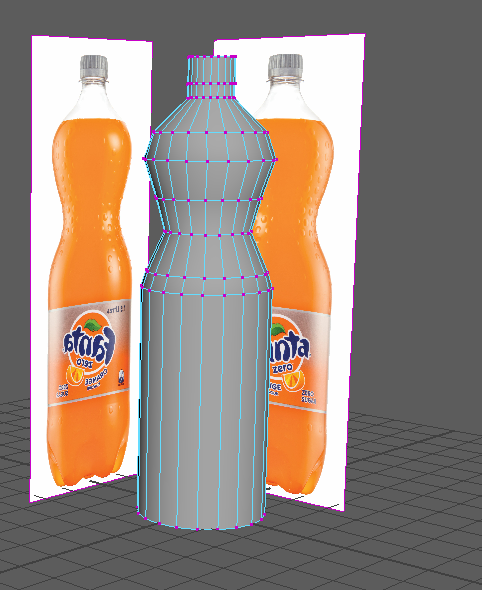
14/3/16 - Modelling the Bottle
I've started modelling the fanta bottle. Originally I was going to wing it and model from memory. Lauren mentioned referenced so I pulled some up online and made free image planes to work with. I also have a fanta bottle in reality to reference.

Friday, 11 March 2016
11/3/16 - Character

11/3/16 - Prince of Persia and Ludus
In "Prince of Persia The Sands of Time" I found the story nodes such as when you got to a certain point in the mission like a new room to be helpful but also broke the flow of the game. In particular I found that the forced camera angles in the rooms were very distracting and took me out of the experience because I felt as though I was fighting the game for merely being able to see.
This game is very ludic because I found myself playing "to win, to beat the game, and story is mostly a lure into the game world."* Every room presented a puzzle that I had to complete to progress the story without any choice over how my character felt about the situation or whether he wanted to do it any other way. This is a very guided path that goes well from node to node. Albeit, as mentioned before, the flow of the game is very interrupted by repeating animations of things like the character putting away his sword or drinking water. These animations don't really add to the character and only take control away from the player and time. Sure, there's the story of him doing these actions - but it is not worth the removal of control.
Camera angles were also largely taken away from the players control when the camera locked on a wall. This is odd considering that originally the player is presented with control over the camera angles using the mouse. Giving someone something only to take it away soon after with no explanation is confusing at best.
Overall, I think the game gets in the way of itself too much in terms of mechanics. The story is there, and in saying that the story isn't great. The puzzles serve the purpose of conveying distance covered, but the fighting with enemies feels tedious. If more control was granted to the player this could be a more successful game.
* From Narrative Games to Playable Stories: Toward a Poetics of Interactive Narrative by Marie-Laure Ryan
Subscribe to:
Posts (Atom)